AI Product Manager Jobs Are Up 400%. That's Bad News.
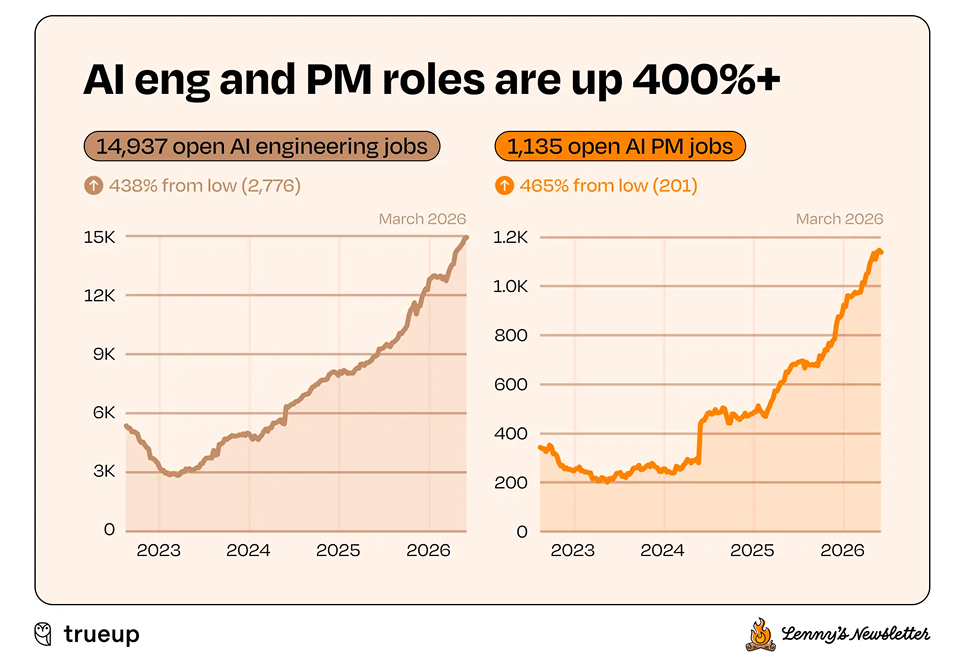
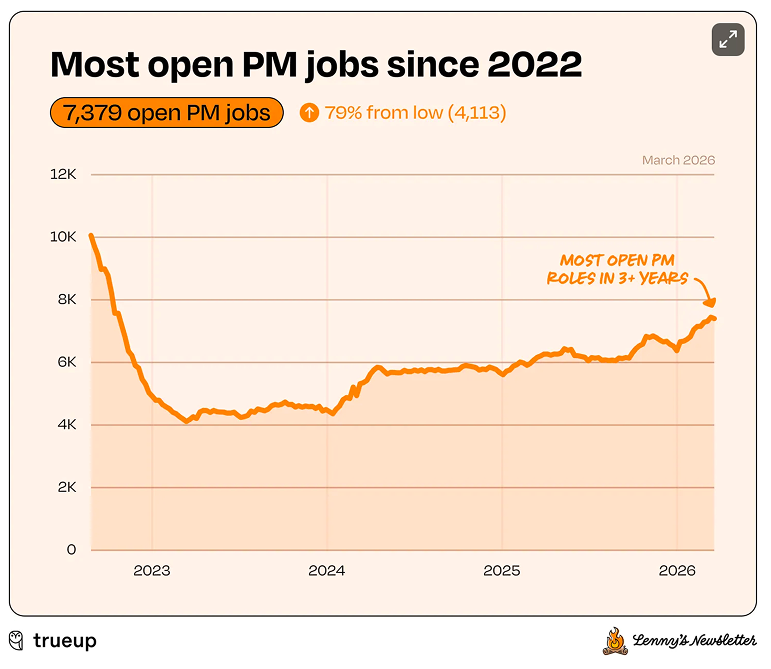
(Op-ed) AI Product Manager jobs are up 400%. Classic Product Manager roles are at their highest level since 2023. Nobody is asking whether the model still makes sense.
And certainly not the PM x Agile consulting industry, already worth tens of billions.
Why is it bad news?
Because the Product Manager model has shown its limits for years, and its inefficiencies are going to be amplified by AI.
Let me explain.
The Product Manager model is what I call a "kick-and-rush" model. Focused on speed, it is a feature factory to push your product to maturity as fast as possible. The initial founder vision guides you to maturity stage, while the verticality and power concentration of the PM reduces debate to a minimum.
This model's specs better match VC-funded scale-ups in the pre-AI era. For other configurations, it is less obvious.
When the product reaches maturity, the cracks appear. You start creating solutions looking for problems and the result is feature stacking. Your product line also becomes fragmented. No one is there to take a step back. Meanwhile, new competitors enter the market, new technologies redefine it. The product operating model you built is now blocking you from questioning and reframing.
But beyond this: why is this model particularly not adapted to the AI era?
As Jensen Huang, Nvidia's CEO, said: "I don't use AI to think for me."
By taking over execution, AI is moving human added value from execution to strategic and critical thinking, redefining the relationship between humans and work. The PM model promotes the opposite.
To optimise speed, it concentrates power on the PM, who cumulates trade-offs, orchestration, and ownership of business model, customer access, and/or product vision. It creates conflicts of interest. It neutralises design, engineering, and marketing / sales from thinking strategically in their domain, while asking the PM to master skillsets far beyond theirs. The model blocks excellence on one hand and maximises weakness on the other.
And why overload the PM when stakeholders could contribute better?
PM advocates argue that AI will solve that. If it does, it means AI will cover what the PM doesn't know, what the PM cannot question or challenge. AI will do the thinking for the PM. So the PM will be the AI... That is the path to generalised incompetence at scale.
Instead of improving the existing matrix, we need to create a new frame. The AI-era product operating model will make the three core product functions (design, engineering and marketing) own their strategic layer again. With the project manager as neutral orchestrator, and the only role without a conflict of interest to arbitrate trade-offs.